
Product overview
Lapping and Polishing Consumables: Which Product Does Your Enquiry Need?
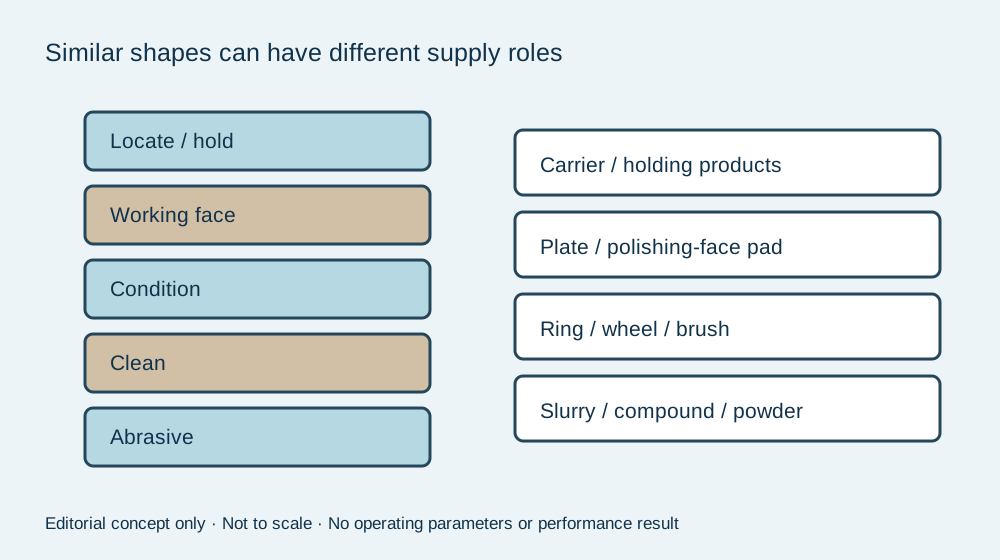
A precision-finishing supplier range can include several circular products that serve different purposes. A carrier, plate, pad, ring and brush are not interchangeable simply because each is a disc. Start by identifying the role of the required item. This product map helps a buyer choose the relevant supply category without turning the website into a process manual or a diagnosis of an unverified production problem.
Workpiece location and holding products
Double-side lapping carriers locate components in pockets and have a machine-specific external interface. Single-side holding pads and templates belong to another mounting arrangement. Within carriers, metal, resin and composite constructions are separate options. The first purchase question is which fixture or component is being replaced. Its drawing or existing reference then defines the supplied geometry; the generic name alone does not identify a compatible substitute.
Working-face plates and polishing pads
A lapping or grinding plate and a polishing-face pad describe different products in the working-surface category. Keep face construction, groove layout, cut shape and backing information separate when identifying a replacement. A holding pad is not another name for the pad on a polishing face. NewwaySmart’s plate and PU pad categories provide separate enquiry routes so buyers need not untangle these names from a single undifferentiated consumables offer.
Conditioning and cleaning tools
Conditioning rings, wheels and abrasive discs have their own working surfaces and connections. Cleaning brush discs and specialised cleaning media belong to a different category again. An enquiry should identify the tool, its interface and the intended supply scope rather than assume that any ring or soft disc does the same job. Website photographs can clarify the form, but a specific replacement needs the agreed reference and any essential dimensional information.
Liquids, compounds and the limits of a product map
A slurry, concentrate, paste or dry abrasive is a distinct supply form. State the product identity and quantity basis when requesting it. These consumables may be used in a wider finishing arrangement, but this map does not claim that one bundle resolves every scratch or yield problem. If the concern is an observed defect, separate that observation from the suspected cause. Enquire about the actual product first; any broader application review is agreed privately.
Buyer questions
Should every enquiry include the whole finishing system?
No. Identify the product and supply requirement first. Include related context only when it helps define the actual item or requested alternative.
Does changing one consumable guarantee a defect disappears?
No. A product range or category description is not a diagnosis or a verified outcome for your application.